What is a Gaussian Splat?
Published:
In the previous post we got as far as a point cloud: thousands of dots floating in space, each one a speck of the plant the software was confident about.
A point cloud is not yet a model, though. It is a set of samples with nothing in between them. Zoom in and the plant dissolves into gaps.
The usual next step
The standard move is to build a mesh: stretch a skin of tiny triangles over the points so that the gaps close and you have a continuous surface.
This works beautifully, and almost all of computer graphics is built on it. A coffee mug, a car door, a museum statue — a mesh describes all of them well, because they are exactly what a mesh assumes: solid, opaque objects with a clean boundary between inside and outside.
Plants break every one of those assumptions
A leaf is not solid. It is a sheet, thin enough that “inside” barely exists — so the mesh has to represent it as two surfaces almost touching, or one surface with no thickness at all, and neither is comfortable.
A leaf is not opaque either. Hold one up to a window and you can see the light coming through. A triangle is either there or it is not; it has no vocabulary for partly.
And a canopy hides itself. Leaves occlude other leaves, so the point cloud always has regions no camera ever saw. The mesher must do something there, and what it does is guess — bridging across a gap, welding two separate leaves into one because they happened to pass close together, or leaving a ragged edge where the blade actually continued.
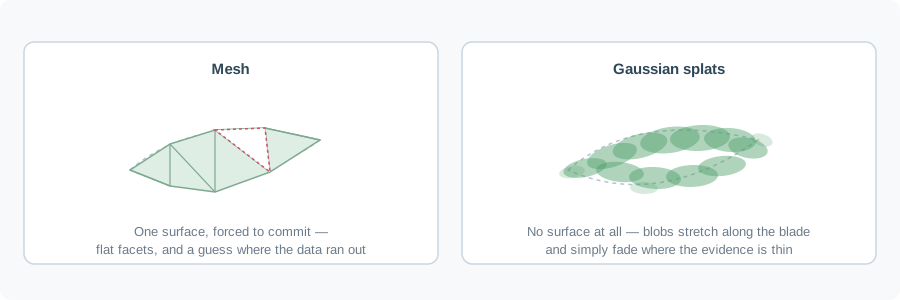
That last point is the one that matters most to me. A mesh has to commit. Every triangle is a hard assertion that the surface is exactly here — and where the evidence was weak, it asserts anyway, silently, with no mark to tell you which parts were measured and which were invented.
A different representation
So drop the surface. Instead of one skin, describe the plant with a large number of soft, semi-transparent blobs.
Each blob is a 3D Gaussian: a fuzzy ellipsoid, densest at its centre and fading smoothly outward, with no edge anywhere. It carries only a few numbers — where it sits, its shape and orientation, its colour, and how opaque it is. A scene is a few hundred thousand to a few million of them, overlapping.
To render, you project every blob onto the image plane, sort them by depth, and blend them front to back. That is all — no ray tracing, no surface intersection. Blending flat shapes is something graphics hardware is extremely good at, which is why a splat scene renders in real time. The name comes from that step: each blob is splatted onto the screen.
Where the blobs come from
They are not designed. They are fitted.
Start with the point cloud from the previous post and put one blob at each point. Now render that mess from a camera position where you happen to have a real photograph, and compare the two images. They will not match.
The crucial property is that the render is a differentiable function of every blob’s parameters. That means you can compute, for each blob, which way to nudge its position, stretch its shape, or shift its colour so the render moves closer to the photograph. Do that across all your photographs, tens of thousands of times over, and the blobs settle into an arrangement that reproduces every view you captured.
The optimiser also controls the population. Where the error stays stubbornly high, it splits and clones blobs to add detail; where a blob has drifted to near-zero opacity, it deletes it. Nobody specifies how many blobs a plant needs.
And nobody ever tells it what a leaf is. The only instruction is: your renders should look like my photographs.
Why this suits a plant
An ellipsoid can stretch. A blob can flatten into a thin disc lying along a leaf blade, or draw out into a long needle running up a stem or a tendril. That directional freedom — anisotropy — comes for free, and it means fine structures do not need many blobs, just well-shaped ones.
Opacity is per-blob and continuous, so translucency and soft edges are expressible rather than approximated. And it gives the representation something a mesh cannot have: where the photographs were ambiguous, blobs simply stay faint. The model declines to assert a surface instead of inventing one.
There is also no topology to get wrong. Two leaves that pass close together stay two clouds of blobs. Nothing welds.
What it does not give you
Two honest limitations.
First, it is a representation built for rendering, not for measuring. Ask a splat model “where exactly is the leaf surface?” and there is no single answer — the whole point is that it never drew one. Getting a leaf area out of a cloud of fuzzy blobs is real work, not a lookup.
Second, and more importantly for this series: splatting inherits the problem from the last post completely. The blobs live in the same arbitrary-unit space the point cloud came from. Gaussian Splatting improves how faithfully the model looks like the plant. It does nothing at all about how big the plant is.
So we now have a beautiful, high-fidelity model of a plant — of unknown size.
Next in this series: how to measure a plant’s traits without ever fixing the scale.