How a computer sees a plant in 3D
Published:
In the previous post I described the problem with measuring plants by hand: it does not scale, it is inconsistent, and the most accurate methods destroy the plant. The obvious way out is to photograph the plant instead and measure the photographs.
But a photograph is flat. A plant is not. So how do you get from one to the other?
Two eyes, one distance
Start with something you already do without thinking. Hold a finger up in front of your face and close one eye, then the other. Your finger appears to jump sideways against the background.
That jump is the whole idea.
Your two eyes see the world from positions about six centimetres apart, so each one gets a slightly different image. Near objects shift a lot between those two views; distant objects barely shift at all. Your brain reads the size of the shift and turns it into a sense of depth.
A computer does the same trick, with one important relaxation: the two views do not have to arrive at the same instant, and they do not have to come from a fixed pair of eyes. One camera, moved to a new position, gives you the second view just as well.
Walk around the plant
So the recipe is: take many photographs of the plant from many positions, walking around it as you go.
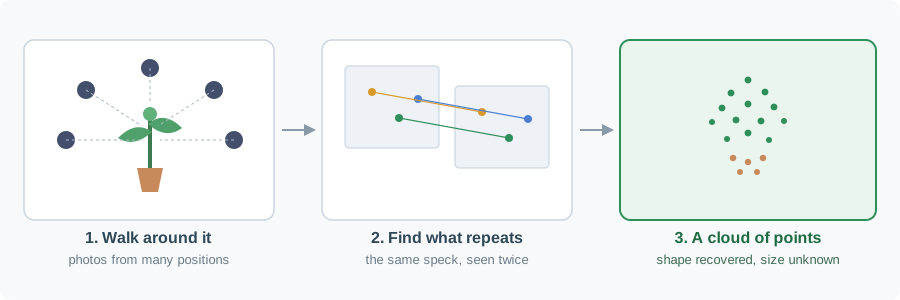
Now the software looks for features — small, distinctive patches it can recognise again in another photo. The tip of a leaf, a notch on a stem, a speckle of texture on the soil. Anything visually unusual enough to be picked out twice.
Then it plays matching. This patch here, in photo 12 — is it the same physical speck as that patch there, in photo 13? Do this across thousands of features and hundreds of photos, and something remarkable falls out.
Each matched feature imposes a constraint. If this speck appears here in one photo and there in another, then the two cameras must have been in particular positions relative to each other and to the speck — otherwise the numbers do not add up. Pile up enough constraints and only one arrangement satisfies them all. The software solves for that arrangement, recovering where every photo was taken from and where every speck sits in space, simultaneously.
This is Structure-from-Motion: structure, recovered from the motion of the camera. The output is a point cloud — thousands of dots floating in 3D, each one a speck the software was confident about, together tracing the shape of the plant.
The catch
Here is the part that surprises people, and it is the reason my research exists.
That reconstruction is faithful in every respect but one. The proportions are right, the shape is right, the geometry is right. The size is not determined.
Think about why. Every constraint in the process came from comparing photos to each other. Nothing in the process ever compared a photo to a ruler. A large plant photographed from far away and a small plant photographed from close up produce identical images — so nothing in the images can distinguish them.
The reconstruction therefore comes out in arbitrary units. It is a perfect model of the plant at an unknown scale, and “unknown” means it can land differently every time you rebuild. Same plant, Tuesday and Friday, two different scales — and any measurement in centimetres is meaningless until you pin that scale down.
The usual answer is to put an object of known size in the scene, like a chequerboard target, and let the software calibrate against it. That works. It also means someone has to place and maintain that target in a working greenhouse, every session, forever.
The alternative is to stop needing the scale at all. That is what the next post is about.
Next in this series: what a Gaussian Splat is, and why it suits a leafy plant better than a mesh.