What is plant phenotyping?
Published:
If you grow tomatoes in a greenhouse, you already know that two plants from the same seed packet, planted on the same day, can end up looking nothing alike. One is tall and leggy; the other is compact with heavy fruit. Same genes, different outcomes.
That gap is what phenotyping is about.
Genotype and phenotype
A plant’s genotype is its genetic code — fixed at the seed, the same in every cell. Its phenotype is what the plant actually becomes: how tall it grows, how many leaves it puts out, how much light those leaves catch, when it sets fruit, how it responds to a cold night or a dry week.
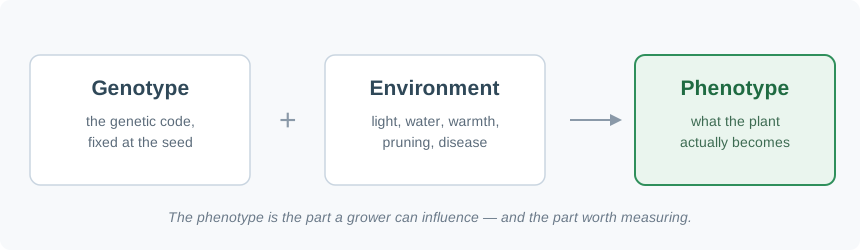
The phenotype is the genotype plus everything that happened to the plant. Temperature, light, water, nutrients, pruning, disease pressure — all of it lands in the phenotype.
This matters because the phenotype is the part a grower can actually influence. You cannot change the seed once it is in the ground, but you can change the climate, the irrigation, and the pruning schedule. To know whether those decisions are working, you have to measure the plant.
What gets measured
Phenotyping means measuring traits — the observable, quantifiable properties of a plant. A few that matter in a greenhouse:
- Height — a direct readout of vegetative growth rate.
- Leaf area — roughly, how much surface the plant has for photosynthesis.
- Stem diameter — an indicator of vigour and how much load the plant can carry.
- Biomass — total accumulated growth.
- Fruit count and size — the part that actually gets sold.
Measure these once and you have a snapshot. Measure them every few days across a season and you have a growth curve, which is far more useful: it tells you not just where the plant is, but where it is heading, and whether last week’s change to the irrigation schedule did anything.
Why this is hard
Here is the problem that motivates most of my research: the traditional way to collect these numbers is for a person to walk into the greenhouse with a ruler, a tape measure, and a notebook.
That approach has three failure modes.
It does not scale. Measuring one plant carefully takes a few minutes. A commercial greenhouse holds thousands. Nobody measures every plant, so growers sample a handful and hope those represent the rest.
It is inconsistent. Where exactly is the “top” of a plant that is bending under fruit? Two people will answer differently, and so will the same person on a Friday afternoon. When you are looking for a 5% change in growth rate, measurement noise of that size hides the signal you care about.
It is destructive. The most reliable way to measure biomass or leaf area is to cut the plant down, dry it, and weigh it. You get one excellent measurement, and you no longer have a plant. That rules out ever watching the same individual grow over time.
This last point is the sharpest one. The most interesting questions in crop science are about change — how a plant responds over days and weeks — and the most accurate traditional methods destroy the very thing you wanted to track.
The alternative
The obvious idea is to replace the ruler with a camera. Take images, reconstruct the plant in 3D, and measure the reconstruction instead of the plant. Nothing gets cut, the same plant can be measured every day, and a robot can do the walking.
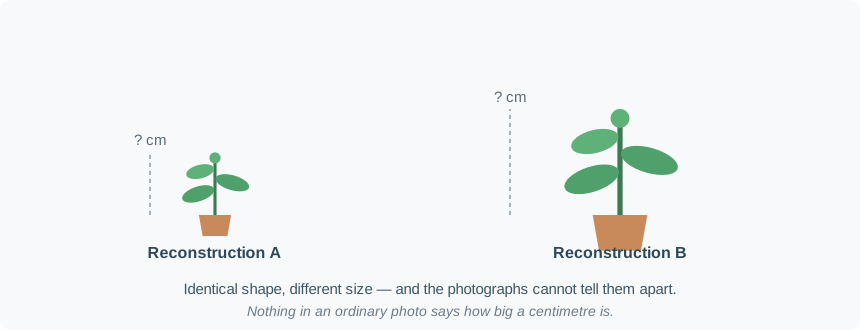
This is roughly what my research does, and the idea is sound. But it introduces a new problem that is not obvious until you try it: a 3D reconstruction built from ordinary photographs recovers the plant’s shape faithfully, while its size is ambiguous. Rebuild the same plant on Tuesday and again on Friday, and the two models may come out at different scales — not because the plant changed, but because the reconstruction has no built-in sense of what a centimetre is.
Which means the measurements drift between sessions, and you are back to noise swamping signal.
That problem — and what to do about it — is the subject of the next few posts.
This is the first in a series of introductory posts on the ideas behind my research. Next: how a computer builds a 3D model of a plant from ordinary photographs.