Video Requirements
What your input videos must look like for successful 3DGS reconstruction.
Camera Setup
Validated Hardware
| Property | Specification |
|---|---|
| Camera | Google Pixel 6a |
| Resolution | 3840 × 2160 (4K UHD) |
| Recording frame rate | 60 fps |
| Format | MP4 (H.264) |
| Duration | ~60 seconds per video |
| File size | ~2 GB per video |
📸 Screenshot to capture
Take a photo of your actual camera and greenhouse setup — show the camera position relative to the plant.
 Camera mounted on stable tripod at fixed height, ~1.0–1.5 m from plant. Tripod is essential — any movement causes blur.
Capture Protocol
Step 1: Camera Position
The camera is fixed at one position — the plant rotates into view via orbital movement of the operator walking slowly around the plant.
Condition 1 vs Condition 2
Our dataset uses Condition 1: single fixed viewpoint. We tested multiple viewpoints and Condition 1 achieved the best PSNR (23.71 dB) because consistent framing yields better temporal comparisons.
Step 2: Lighting Requirements
| Condition | Status | Why |
|---|---|---|
| Capture time: 12:00–13:00 JST | ✅ Required | Consistent natural light, minimal shadows |
| Overcast sky | ✅ Preferred | Diffuse lighting = fewer specular reflections |
| Direct harsh sunlight | ⚠️ Avoid | Creates extreme shadows that confuse COLMAP |
| Artificial lighting only | ⚠️ Avoid | Color temperature mismatch between dates |
📸 Screenshot to capture
Take a photo of the greenhouse interior showing lighting conditions at capture time.
 Ideal greenhouse lighting: diffuse, even illumination. Harsh shadows on the plant will reduce COLMAP feature matching quality.
Good vs Bad Video Examples
Frame Quality Checklist
📸 Screenshot to capture
Extract one representative frame from a good video and one from a bad video for comparison.
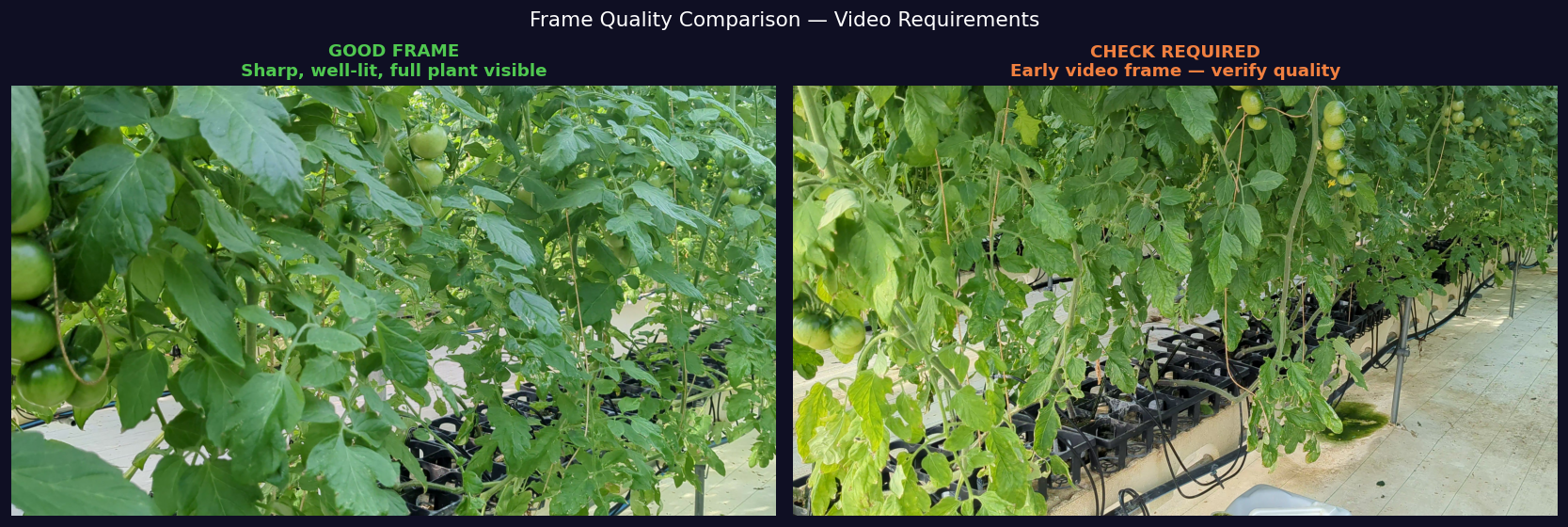 Left: Good frame — sharp, well-lit, plant fully in frame. Right: Bad frame — motion blur from camera shake will cause COLMAP feature detection to fail.
- Sharp leaf edges (no motion blur)
- Plant fully visible in frame
- Even lighting, no overexposed areas
- Consistent background (no people walking through)
- Motion blur (tripod moved, or handheld)
- Plant partially out of frame
- Overexposed/underexposed
- Foreground obstruction
Pre-Capture Checklist
Before every recording session:
- Camera battery > 50%
- Storage: > 5 GB free on device
- Tripod: fully locked, no wobble
- Time: 12:00–13:00 JST
- Plant: fully in frame, no clipping at edges
- Focus: locked on plant (disable auto-focus)
- Stabilization: OFF (optical stabilization introduces warping)
- Duration: record for full 60 seconds minimum
Environmental Metadata (Important for Research)
For time-series analysis, record these values at each capture date:
| Variable | How to Measure | Why It Matters |
|---|---|---|
| Temperature (°C) | Greenhouse sensor | Correlates with PSNR |
| Humidity (%) | Greenhouse sensor | Strongest negative PSNR correlation (r = -0.68) |
| Solar radiation (W/m²) | Pyranometer | Radiation > 100 W/m² → lower PSNR |
| CO₂ (ppm) | CO₂ sensor | Secondary growth factor |
📸 Screenshot to capture
Screenshot your greenhouse sensor dashboard or data logger at each capture time.
 Log all environmental variables at each capture. Humidity and radiation have the strongest correlation with reconstruction quality.
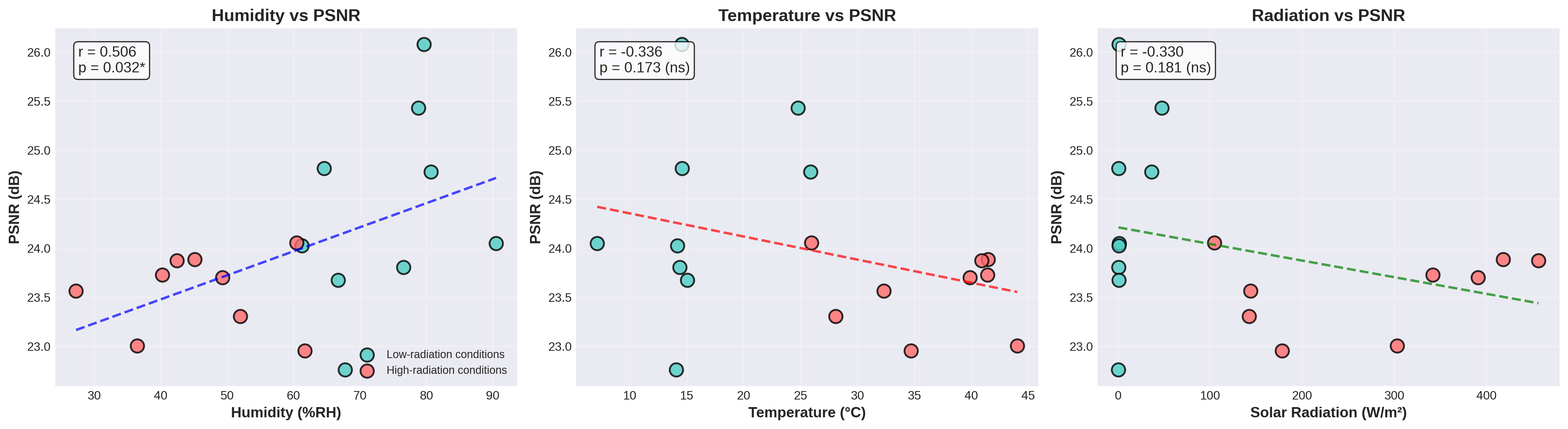 Environmental correlation analysis: humidity shows the strongest negative correlation (r = -0.68) — high humidity reduces PSNR by increasing foliage reflectance variance
Dataset Summary
Our validated dataset used in this research:
| Property | Value |
|---|---|
| Total recording days | 49 days |
| Usable capture dates | 22 |
| Excluded dates | 28 (poor conditions, equipment issues) |
| Video duration | ~60 seconds each |
| Plant species | Tomato (Solanum lycopersicum) |
| Growth stage | Seedling → mature plant |
| Capture location | Happy Quality greenhouse, Fukuroi city, Shizuoka |